Heat Pump Dryers: Reduce Laundry Energy Costs by 50 Percent in 2026
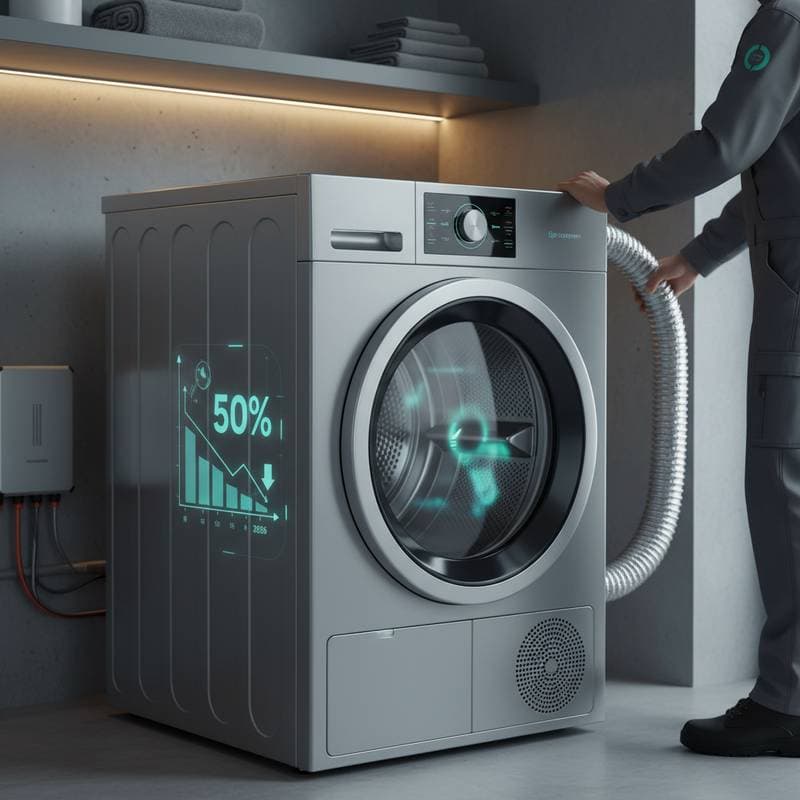
Homeowners seeking substantial reductions in laundry energy expenses should consider heat pump dryers as a leading option. These innovative appliances employ heat recovery technology to dry garments using up to 50 percent less energy than conventional electric or gas dryers. This article examines the mechanics of heat pump dryers, their pricing, advantages, and the transition process to integrate one into your routine.
| Item | Average Cost |
|---|---|
| National Average Cost | $1,200 - $1,800 |
| Typical Price Range | $1,000 - $2,000 |
| Extreme High-End | $2,500+ |
| Extreme Low-End | $900 |
Average Costs of Heat Pump Dryers
Heat pump dryers generally range from $1,000 to $2,000, influenced by factors such as capacity, manufacturer, and efficiency specifications. Although the initial investment exceeds that of traditional vented dryers, the energy efficiencies often recoup the expense through diminished utility payments.
Cost Variations by Model Type
- Entry-Level Models ($900 - $1,200): These units feature reduced capacity, essential functions, and moderate drying speeds, suiting smaller households.
- Mid-Range Models ($1,200 - $1,800): Equipped with Energy Star certification, diverse drying cycles, and humidity detectors for accurate outcomes.
- High-End Models ($1,800 - $2,500+): Offer expansive drums, wireless connectivity, accelerated operations, and subdued noise levels for superior functionality.
To assess total ownership expenses, evaluate the acquisition price alongside projected energy reductions. Many families observe utility bill decreases within the initial year of operation.
Factors Influencing Heat Pump Dryer Pricing
Multiple elements determine the cost of a heat pump dryer. Grasping these aspects enables informed selection aligned with household requirements and financial plans.
Capacity and Dimensions
Capacity appears in cubic feet measurements. Units at approximately 4 cubic feet prove more affordable yet accommodate limited loads, whereas models exceeding 7 cubic feet command higher prices while processing larger volumes per cycle. Select dimensions that correspond to your laundry demands to optimize energy utilization.
Manufacturer and Construction Standards
Established brands command premium prices due to sophisticated engineering, enhanced longevity, and comprehensive warranties. Such investments yield extended service and minimal repair needs over time.
Efficiency Certifications
Prioritize units bearing the Energy Star designation. These incorporate sophisticated heat exchange mechanisms that recapture and recirculate warmth, eschewing wasteful expulsion. The sealed system design achieves energy reductions of up to 50 percent relative to conventional dryers.
Setup and Ventilation Needs
Heat pump dryers operate without vents, facilitating placement in diverse settings like apartments or structures lacking ductwork. Nonetheless, requirements for updated wiring or drainage may elevate installation fees marginally.
Categories of Heat Pump Dryers
Heat pump dryers vary in design to address particular spatial and functional demands.
Compact Heat Pump Dryers
- Advantages: Suited for confined areas such as apartments, they consume minimal electricity and eliminate venting necessities.
- Disadvantages: Limited drum sizes necessitate more cycles for substantial laundry quantities.
Full-Size Heat Pump Dryers
- Advantages: Manage extensive family loads, deliver quicker cycles, and integrate sophisticated options.
- Disadvantages: Incur greater initial costs and marginally higher power usage than compact variants.
Integrated Washer-Dryer Units
- Advantages: Merge washing and drying functions into a single device, ideal for space-constrained environments.
- Disadvantages: Exhibit prolonged cycle durations and diminished capacities versus standalone appliances.
Connected Heat Pump Dryers
- Advantages: Provide app-based remote access, connectivity features, and adaptive sensors for optimized drying.
- Disadvantages: Entail elevated costs and heightened repair intricacies.
Indicators for Dryer Replacement
An underperforming or faulty dryer warrants consideration of a heat pump upgrade for cost efficiencies and reliability. Common signals include:
- Extended drying periods for garments compared to prior performance.
- Excessive heat emission or humidity release during use.
- Unaccounted rises in energy statements.
- Abnormal sounds or odors resembling burning.
- Recurrent interruptions or startup failures.
- Necessity for repeated cycles on dense materials.
Transitioning to a heat pump dryer addresses these concerns and yields prompt energy benefits.
Installation Procedure for Heat Pump Dryers
The setup of a heat pump dryer proceeds efficiently, though familiarity with the steps proves beneficial.
- Evaluation: Technicians inspect the space for suitable power sources, airflow, and drainage provisions.
- Transport and Positioning: Existing equipment receives removal, followed by alignment and stabilization of the new unit.
- Power Integration: Connection occurs to a 240-volt supply for standard models or 120-volt for smaller ones.
- Moisture Management: Water condensation directs to plumbing or a collection reservoir.
- Verification: A complete cycle tests heating and drying efficacy.
- Guidance Session: Instructions cover controls, upkeep, and lint management.
Expert installation fees range from $100 to $300, varying by region and project scope.
Labor Expenses for Heat Pump Dryer Setup
Installation labor typically spans $150 to $250, encompassing unit removal, connections, and drainage configurations. Supplementary electrical or plumbing modifications may add $100 to $200.
Engaging qualified professionals guarantees safe and optimal function. Faulty setups risk moisture accumulation or efficiency losses.
Common Questions on Heat Pump Dryers
Do Heat Pump Dryers Justify the Elevated Cost?
Affirmative. The initial outlay recoups through energy economies within several years. Additionally, gentler temperatures preserve fabric integrity, prolonging apparel durability.
Do Heat Pump Dryers Require More Time to Dry Garments?
They may extend slightly beyond vented counterparts owing to moderated temperatures. Contemporary designs, however, utilize sensors and refined air circulation to shorten durations while upholding savings.
Can Heat Pump Dryers Install in Any Location?
Indeed, ventless configurations adapt to most sites with power access and drainage alternatives. They excel in apartments, closets, or vent-absent residences.
What Energy Savings Are Achievable?
These dryers consume up to 50 percent less power than standard electric models, yielding notable yearly reductions in electricity expenditures.
Do Heat Pump Dryers Require Maintenance?
Yes, routine care involves lint filter cleaning after each use, condenser coil inspections quarterly, and water tank emptying as needed. Such practices maintain peak performance and prevent efficiency declines.
Are Heat Pump Dryers Noisy?
Generally, they operate more quietly than traditional dryers, thanks to enclosed systems and lower-speed components. Noise levels often fall below 60 decibels, comparable to a normal conversation.
Adopt Efficient Laundry Practices
Integrating a heat pump dryer represents an accessible method to diminish energy demands by half, enhance garment preservation, and elevate household convenience. The investment returns via reduced bills, durable equipment, and refined operations.
For impending upgrades, solicit estimates from accredited specialists and prioritize Energy Star units fitting your space and usage patterns. This approach ensures expedited drying, financial gains, and sustainable living from your initial cycle onward.